The Sign of Mary
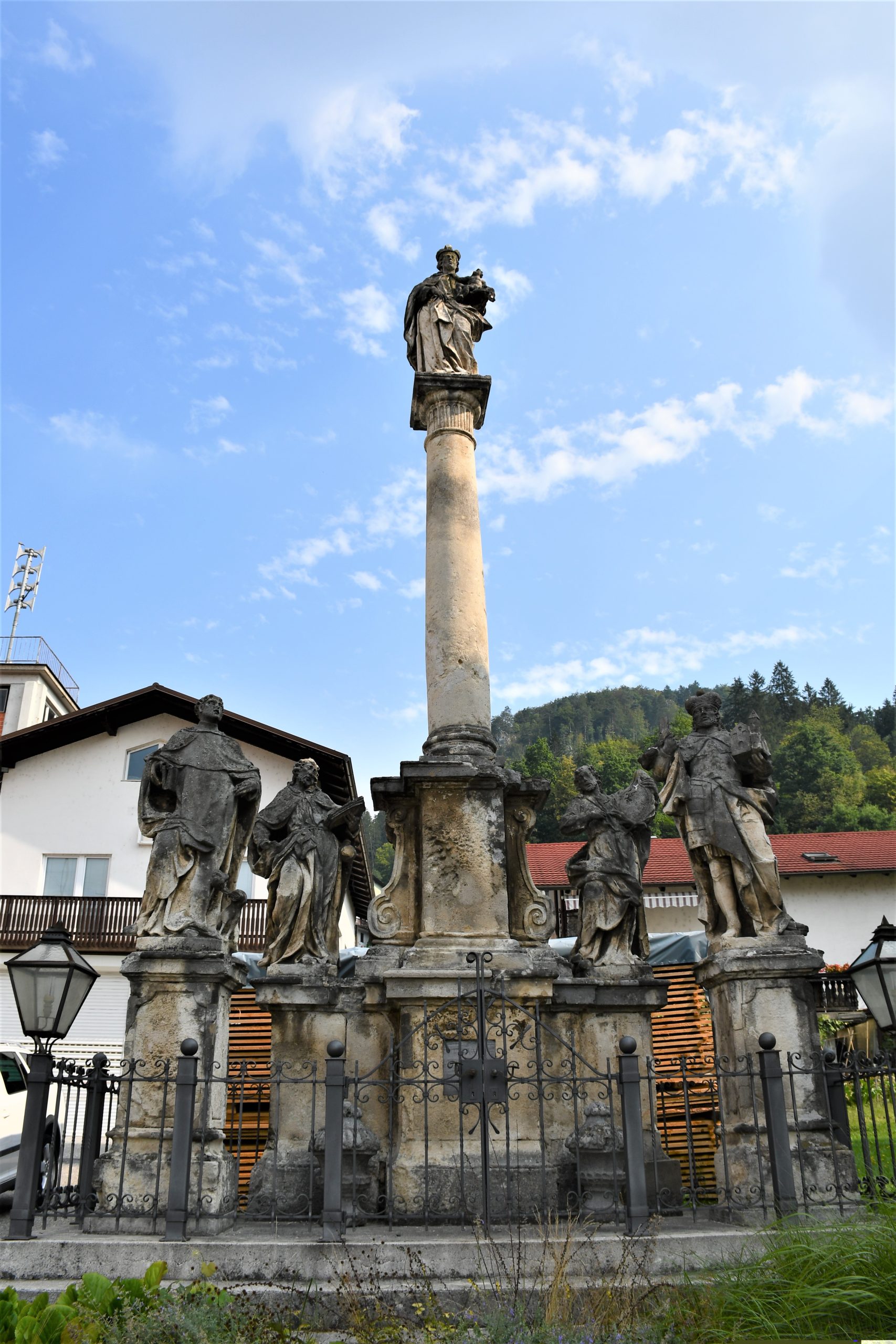
In 2024, the Department of Stone and Stucco of the ZVKDS Restoration Centre completed the comprehensive restoration of the Marian Marian Sign from Radlje ob Dravi, which began with the preparation of a conservation plan in 2018 and continued with surveys and dismantling in 2020.
Text. Špela Govže


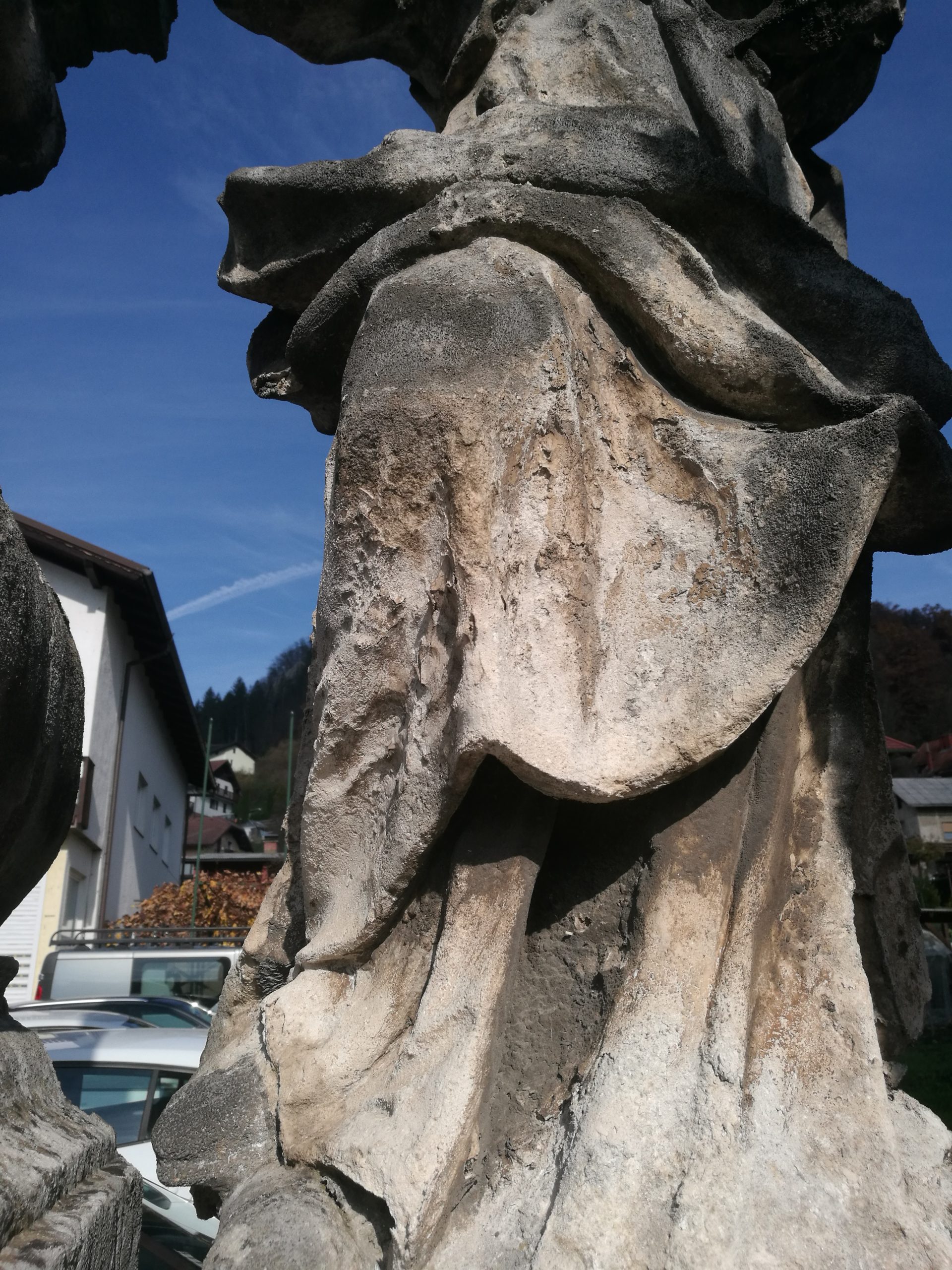
This year, the Department of Stone and Stucco of the ZVKDS Restoration Centre completed the comprehensive restoration of the Marian Marian Monument in Radlje ob Dravi, which began with the preparation of a conservation plan in 2018 and continued with surveys and dismantling in 2020. It is a large and complex project that required the collaboration of experts from various disciplines and institutions, as the material substance of the monument had been severely degraded.The restoration of the monument was carried out by the ZVKDS Restoration Centre. The statues were completely degraded aesthetically due to the damage and the dark cladding. There was a lot of breakage and loss of detail and of the most exposed elements such as noses, toes and feet. The surface of the statues was completely dusty in some parts. Given the distressed state of the statues, our first thought was to replace the Virgin Mary with a copy and to place the original in a controlled atmosphere or at least under a canopy. Due to financial and space constraints, we decided to convene an international advisory commission, to which we invited, among others, an expert from the Austrian BDA, Mag. Johann Nimmrichter and mag. Gorazd Živkovič. Together we came to the decision to return the original sign to its original location, in front of St Michael's Church in Radlje ob Dravi, after thorough conservation and restoration work had been completed and the sacrificial layer had been applied.
The dismantling and assembly was logistically challenging, both because of the dimensions and the sensitivity of the monuments.
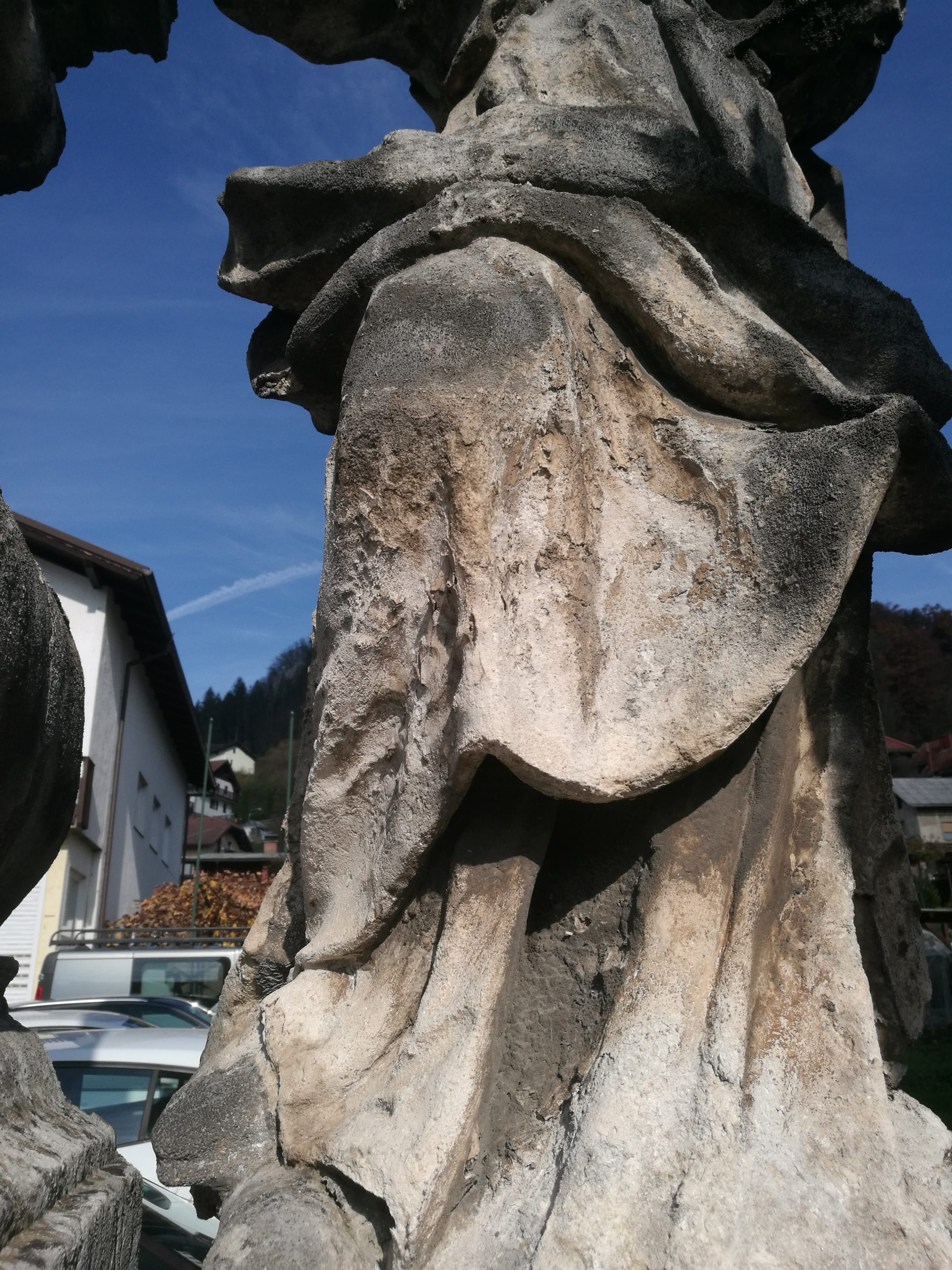
Detail of the lesions before the intervention
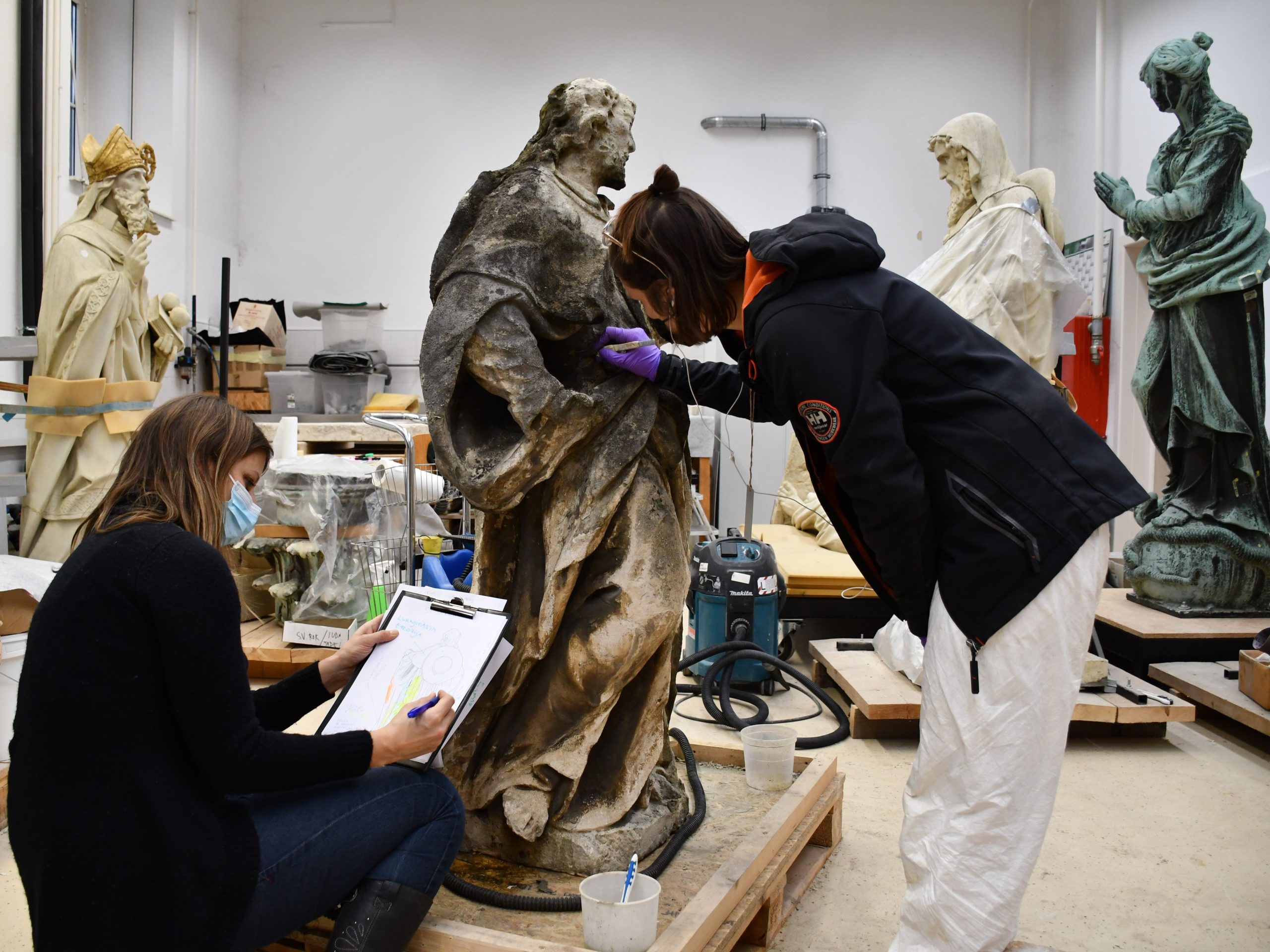
First, we carried out a sounding. It got complicated when removing the secondary linings. We were able to partially remove some of the deposits with water vapour and soft brushes, while some of the stubborn deposits remained on the stone. In order to arrive at the most appropriate cleaning and hardening method, we worked with the natural sciences department of the Restoration Centre, as well as with the Research Institute and the Institute of Civil Engineering. The deposits were then removed using ion exchange resins, cellulose clay pulps with solvents and later also with distilled water alone, mechanically with small tools and locally in some places with lasers.
Before the statues were dismantled, they were locally pre-hardened with Cyclododecane temporary spray hardener. According to the results of the analyses carried out during the preparation of the conservation plan, we chose a hardening agent to harden the fragile parts of the stone. CFW (Consolidation Formulation Water).

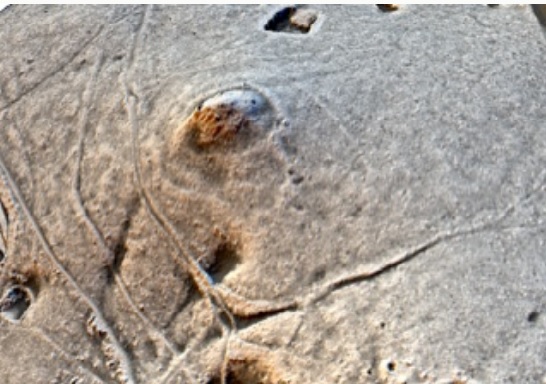
3D data capture, scanning
The restoration of the statue of Siegfried of Marenberg, the founder of the monastery in front of which the sign originally stood, was particularly challenging. After the dissolution of the monastery, the sign was moved to the front of the former courthouse, along the main road. There, in the 1970s, a truck loaded with logs knocked down the statue, which broke into 8 pieces. The restorers of the Maribor unit of the ZVKDS successfully restored it, but over the decades the ties that connected the pieces corroded and the damage began to show. Despite the challenge, as one of the ties was inserted through the entire hull, we decided to locate the worn ties, remove them and replace them with stainless ones.
The missing head of Jesus could be reconstructed thanks to fragments of the face and crown found during the visits and the preparation of the conservation plan under the monument. A sketch in clay was made beforehand, followed by a modelling on the original in a replacement mortar. In the same way, we have also undertaken to fill in other key missing parts on the figures (such as fingers, hands, feet). Minor damage and details have not been filled in.
For the first time, the conservation and restoration work on the Epiphany took advantage of 3D technology to such an extent, complementing the damage to the original stone base in the least destructive way possible.The 15 major damages were 3D laser scanned and inserts were milled from a related natural stone on a CNC machine. They were then hand-fitted to perfectly fit the original and the surface of the stone was finished with spikes and chisels.
In hidden corners of the statues, we found traces of paint and gilding on parts of the Virgin Mary's crown. The sign was protected from atmospheric and other deterioration factors by applying a silicate glaze, as the sign was also once painted white, as natural history investigations have shown. Whether the paint was original or was applied to the mark at a later date cannot be stated with certainty. In addition to the material remains, archival sources on previous restoration work also attest to the gilding of the crown.
During dismantling, we found the year 1742 carved in a small niche on the inside of the base, which is important as the sign has not been dated precisely until now. In addition to the year, the letters M A and L Z are also carved, and between them is a small niche in which a metal box with interesting contents has been placed. Like the box, its contents have been badly weathered, and the box preserves, among other things, a novena, a miniature statuette, a cross and a textile scroll. Due to the deterioration of the material, the box and its contents have been handed over to the National Museum of Slovenia, where it is being studied and conserved, and a special display case will be built for it, to be displayed in the Carinthian Regional Museum in Radlje ob Dravi.
Stages of intervention