Rigonce, surveys in the area of the planned construction of three residential houses

Roman remains

The northern part of the hamlet of Rigonce is situated on slightly higher ground surrounded by palaeo-structures, which probably enclosed (and therefore somewhat protected) a small Roman settlement (Lat. vicus) before the regulation. Prehistoric and Roman finds have been known in the past in Rigonce, and the existence of the settlement is already indicated by the very toponym of this slightly elevated plateau, i.e. Gradišnica.

Text by Gašper Rutar and Miha Murko
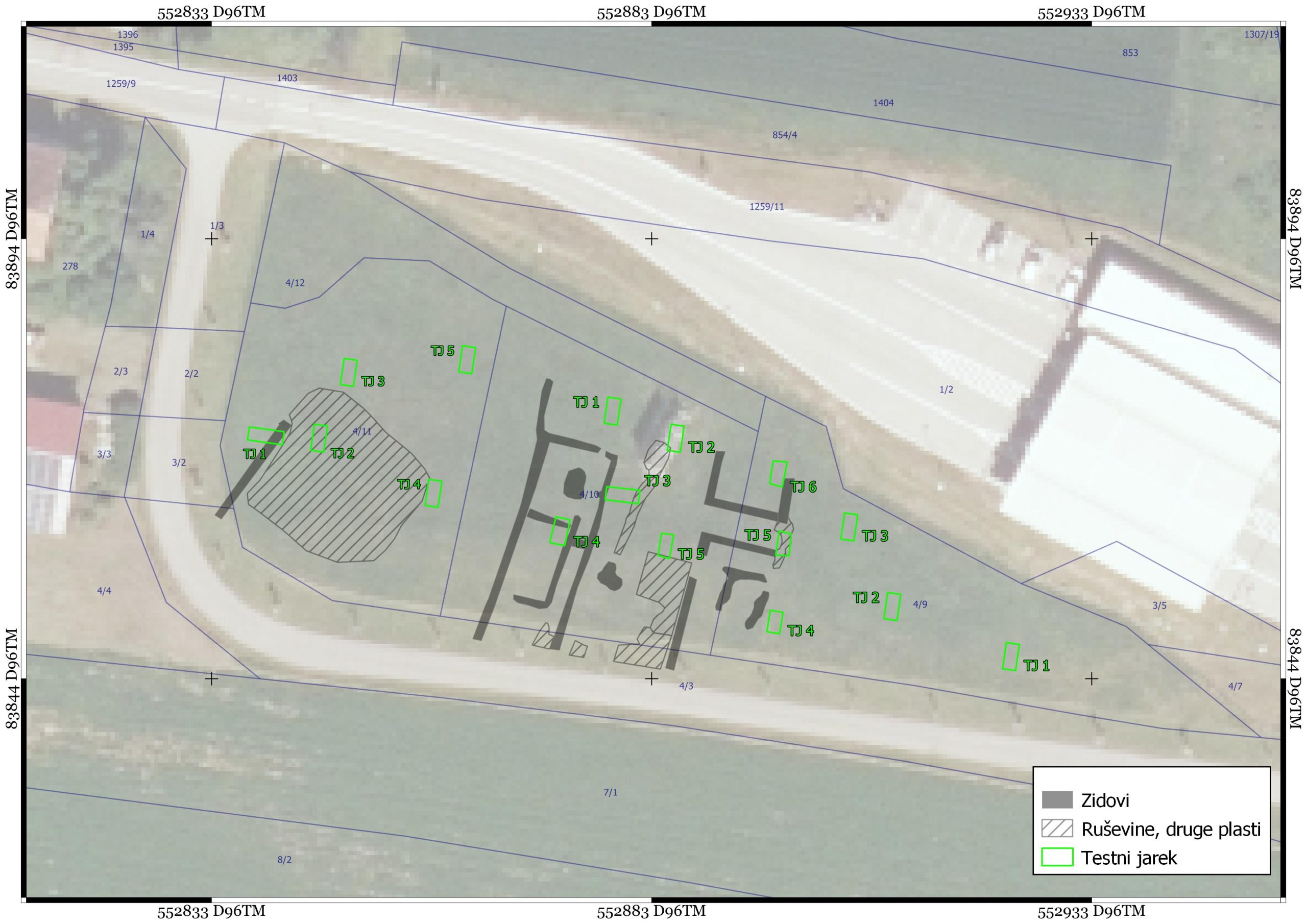
GPR measurements and test trench locations (by Gašper Rutar)
Western cross-section of machine test trench 5, on the construction site of the Kunšek residential house on plot 4/10, Rigonce (photo by M. Murko).

The northern part of the hamlet of Rigonce lies on slightly higher ground surrounded by palaeo-structures, which probably enclosed (and consequently somewhat protected) a small Roman settlement (Lat. vicus). In Rigonce prehistoric and Roman finds have been known in the past, and the existence of the settlement is indicated by the very toponym of this slightly raised plateau, i.e. Gradisnica.

Cultural heritage unit Rigonce - Archaeological site Gradišnica (EID 1-10785) comprises the northern part of the settlement of Rigonce. During excavations in 1992, three Roman wells were discovered in an abandoned sand pit, masonry structures in the eastern part of the village, and surface finds dating from the middle of the 2nd, 3rd and 4th centuries. In the western part of the village (glacier Wide), aerial photographs revealed traces of four structures, and field inspections confirmed their existence. Investigations to the south of the glacier Gradisnica, on plots 5, 24 and 28, all of Rigonce, only recent deposits over natural colluvial and alluvial layers were found (Bavec, Predan 2008), while on plot 8/4, Rigonce, on the eastern part of the glacier GradisnicaIn 2014, remains from the Roman period and individual pottery fragments from the prehistoric and modern periods were discovered in the area of the construction of the Dobova-FTHH Gabrje route and the construction of the fibre optic network in Rigonce (Mason, Arh, Mulh 2020, 26).

All these traces map for the time being the possible extent of the settlement on the raised plateau in the former Sotla river basin.

Geophysical surveys have revealed the remains of a larger structure, 30 m wide and more than 32 m long, apparently extending under the present road to the south. Based on the GPR results, we estimate that the remains of the building are located at a depth of between 0.2 m and 0.7 m. On the west side, (at least) one more wall was detected, but it deviates slightly from the orientation of the larger building in the central part. The other detected responses can most likely be attributed to differences in the composition of the strata, which may be the result of different alluvial deposits as well as use (e.g. mounding and soil consolidation).

The results of the geophysical surveys were confirmed by the excavation of machine-arm test probes. Poorly preserved remains of Roman-period building remains were discovered. Most of the walls of the Roman buildings were very poorly preserved due to looting and intensive ploughing. Some walls were only identified in robber trenches or larger stone graves. During the archaeological excavations, few small finds were uncovered. The finds discovered are mostly from the Roman period, suggesting a date of the site in the 2nd or 3rd century.

Archaeological site, part of which was destroyed by the construction of residential houses, (photo by G. Rutar).
Globočice near Kostanjevica na Krki

Newly discovered Roman villa

Read more

News

Relevant information for owners gathered in one place.

Gruber Palace becomes the new home of the Slovenian Institute for the Protection of Cultural Heritage Ljubljana, 25 February 2026 - Today, the Slovenian Institute for the Protection of Cultural Heritage (ZVKDS) inaugurated its new premises in Gruber Palace in Ljubljana. One of the most important Baroque settings in Slovenia has thus regained its distinct public mission - it has become the central administrative and professional centre of the national institution for the protection of cultural heritage. The premises were opened by the Minister of Culture, Dr Asta Vrečko, and the Director General of ZVKDS, Jernej Hudolin. The Ministry of Culture allocated EUR 370,000 for the renovation. At the opening ceremony, Minister Dr Asta Vrečko emphasised the broader context of the investments in the Institute's premises. The ZVKDS is one of our largest public institutions, with an extensive network of units across Slovenia, a restoration department and an archaeology department. Following the relocation of the Slovenian Archives, we have dedicated the baroque Gruber Palace in Ljubljana to a new public activity - the Institute for the Protection of Cultural Heritage, while renovating it and landscaping the park in front. The administration and various departments have moved in and will now work together, whereas previously some of them worked in rented premises. Last year, we completed the energy renovation of the buildings of the Institute's regional units in Kranj and Ljubljana, and this year we will move the Luška kapitania in Koper, where we will relocate the regional unit in Piran. This will preserve our heritage and create better working conditions for our staff.» The Director General stressed that the merger of key services of the ZVKDS under one roof will bring cost rationalisation, better communication, more efficient work processes and greater cohesion among employees. «Instead of five locations in Ljubljana, we will now work in three - Gruber Palace has become the heart of our operations.» «Today we are gathered in one of the most precious baroque settings in Slovenia. This is not just an architectural jewel. It is a place of knowledge, research, creativity and heritage that has shaped our identity over the centuries.» He added: «We believe that by coming to the palace, we are continuing the centuries-old spirit of exploration, creativity and responsible heritage care.» And he stressed the symbolic dimension of the opening: «This is not just a logistical gain. It is a symbolic gesture: we are the guardians of cultural heritage working in a place that is a world-class cultural monument. We have thus placed ourselves alongside many European heritage services, which are based in outstanding historic buildings.» History of the space Knowledge Gruber Palace was designed in the second half of the 18th century by the Jesuit, architect and scientist Gabriel Gruber as the headquarters of the Jesuit College. From the outset, it was conceived as a place of knowledge, research and teaching. It was the home of many scientists, including Jurij Vega, one of Slovenia's most prominent mathematicians and astronomers. The palace has retained outstanding architectural and artistic elements, including a monumental oval staircase and a richly painted chapel, and remains one of Ljubljana's key Baroque monuments.
25. 2. 2026

Gruber Palace becomes the new home of the Slovenian Institute for the Protection of Cultural Heritage

READ
15. 9. 2025

Slovenian translation of the UNESCO Handbook and Tools for Impact Assessment in the Context of World Heritage is published

READ
Central motif with the main entrance before renovation
24. 11. 2025

Renovation of the façade and joinery of the Bee House in Radovljica

READ

Search page IPCHS